


Olympic Weightlifting Workouts & Training Programs
Program & Workout Help
Tap/click to expand a topic+ Weight/Set/Rep Prescriptions & Notation
Weightlifting prescriptions will be notated with the exercise, the intensity (loading), reps and sets. For example:
Snatch – 75% x 2 x 5
This would indicate snatching 75% of the athlete’s 1RM snatch weight for 5 sets of 2 reps. If a load is not specified, notation for sets and reps will be in the reverse order. For example:
Pull-ups – 5 x 10
This would indicate 5 sets of 10 reps.
For exercise complexes, notation will usually include reps for each exercise performed in the set. This would look, for example, like:
Power Clean + Power Jerk - 75% x 2+1 x 4
This would mean each set is 2 power cleans followed by 1 power jerk at 75%.
Power Snatch + Snatch Balance - 75% x 2(1+1) x 5
This would indicate that each set is 1 power snatch, then 1 snatch balance, then 1 power snatch, then 1 snatch balance for 4 total reps per set.
Prescribed percentages are of the exercise they accompany unless noted otherwise. A notable exception is snatch or clean pulls or deadlifts: percentages of these exercises are calculated from the 1RM of the snatch or clean (this is usually noted in the workout for clarity).
Often exercises will have other types of loading prescriptions, including HS (heavy single) and max.
HS (Heavy Single)
HS or Heavy single indicates taking the exercise to the heaviest weight for a single rep that can be managed in that training session. This is determined simply by gradually increasing the weight until that criterion is met without any failed attempts. If an attempt does fail, but the reason for failure is obviously technical in nature, the athlete can make another attempt. Otherwise the loading increase should stop when the athlete completes a rep he or she is confident is approximately the best possible at that time.
Max
Max is a genuine test of a maximal effort. In this case, the athlete can give him- or herself up to 3 attempts at a given weight. If after 3 attempts the athlete is still unsuccessful, he or she is done with that exercise. An exception would be an athlete who is missing based on minor and known technical errors, and who is able to continue making attempts that are at least as close or better than previous attempts at that weight. In such cases, continued attempts are recommended until this trend reverses.
Similar to the heavy single would be multiple reps with the "heavy" notation, e.g. heavy 3. This simply means taking the exercise up to the heaviest set of 3 reps you feel you're able to do that day.
RM
RM stands for "rep max" and means you'll take the exercise up to a maximum weight for the prescribed reps, e.g. 3RM, 5RM, 1RM. If percentages follow an RM prescription, they are of that day's RM, not of the athlete's current 1RM. For example:
3RM, 90% x 3 x 2
This would mean taking the exercise up to a max weight for 3 reps, then doing 2 more sets of 3 at 90% of that maximum weight.
Sometimes it will be noted alongside RMs that they should not be absolute max testing on that day, but very challenging.
No weight prescribed
If a loading prescription is absent for a particular exercise, the athlete should choose the loading to approximate the heaviest possible for the prescribed sets and reps unless some other quality is prescribed. For conditioning workouts, attempt to select weights that allow you to perform the prescribed reps consecutively in at least the first set.
Bold Weights or Reps
If a weight or rep number is bold, it means that you can increase it for that set if you feel good. This is not a suggestion to take the exercise to a max effort, and you need to stick with the same number of prescribed sets written.
+ Abbreviations
OTM:On The Minute (AKA EMOM)
This is a series of sets performed at the start of each subsequent minute. For example, 75% x 1 x 5 OTM would mean a single at 75% each minute. This is NOT 1 minute rest. If the first set begins at minute 0, the second set begins when the clock hits 1 minute.
HS: Heavy Single
HS or Heavy single indicates taking the exercise to the heaviest weight for a single rep that can be managed in that training session. This is determined simply by gradually increasing the weight until that criterion is met without any failed attempts. If an attempt does fail, but the reason for failure is obviously technical in nature, the athlete can make another attempt. Otherwise the loading increase should stop when the athlete completes a rep he or she is confident is approximately the best possible at that time.
RM: Repetition Maximum
RM stands for "rep max" and means you'll take the exercise up to a maximum weight for the prescribed reps, e.g. 3RM, 5RM, 1RM. If percentages follow an RM prescription, they are of that day's RM, not of the athlete's current 1RM.
+ Exercises
In addition to some well-known exercises, our workouts occasionally use some less-well-known exercises, particularly weightlifting movements. Descriptions and video demonstrations can be found in the Exercise Library.
With exercises requiring higher degrees of technical precision, spend the time developing a solid technique base before attempting to load them heavily. More time invested early in technique work will pay off in the long run.
A good time to do this is prior to the beginning of the next cycle.
Exercise Library
+ Ab & Back Work
Ab work should be performed every training day, even if not prescribed in the workout. Include back work as well at least 1 day/week (e.g. back extensions, reverse hypers, back planks) if not prescribed in the workouts.
Check out this article for info on ab and back work.
+ Rest Periods
Rest as needed between sets without getting lazy. Generally 2-3 minutes is good. For extremely tough work like heavy, high volume squats, 3-5 minutes rest can be taken if needed.
+ Tempo Prescriptions
Certain exercises will be accompanied by a 4-digit number that prescribes a speed at which the lift should be executed. The first digit refers to the eccentric portion (lowering); the second to the time between the finish of the eccentric and concentric portions; the third the concentric (lifting/raising); and the fourth the time between the completion of the concentric and beginning of the following eccentric portion. An "X" indicates performing the portion of the movement as quickly as possible.
For example, a good morning with the tempo 3020 would mean that the athlete would take 3 seconds flex the hip into the bottom positions, not pause, take 2 seconds to extend the hip back to the standing position, and not pause at the top before beginning the next rep.
+ Accessory Work
In addition to the primary weightlifting training, most programs also have accessory work.
In many cases, this work will be done in compound/super sets; that is, you will alternate between or among the exercises rather than completing all sets of each exercise before moving to the next. Such sets will be prescribed with letters and numbers associating exercises in each compound set.
For example:
3 sets:
A1. Pull-ups x 10
A2. Weighted sit-ups
If there were "B" exercises following these, all 3 sets of A1 and A2 would be completed before the B sets were started.
This structure does not mean it's intended to be done quickly—do it at a natural pace. If you do want to get some light conditioning work, you can move through this accessory work as fast as possible BUT prioritize the quality of execution over speed.
Adding Your Own Accessories
Some older programs don't contain accessory work, and at other times you may want or need to add exercises or switch prescribed exercises for others that you know to be most effective for you for that purpose.
This is fine—just be smart about how much you're doing and remember that even seemingly minor, light exercises do add up and affect your recovery.
+ Combining Programs
Many individuals ask if they can perform both our training and other training simultaneously. While we can’t predict everyone’s response to training, we can say with certainly that very few individuals will be able to handle such a workload for any considerable period of time without burning out completely.
These programs are complete and accordingly demanding—attempting to do 2 complete training proprams simultaneously is a recipe for overtraining and poor results.
Just as importantly, combining multiple programs is a good indicator that you're trying to achieve conflicting goals at the same time - this never works well.
If you must combine programs, choose a lower volume and frequency program (use the program filter to select) here and make sure you can manage the workload before considering doing more.
+ Modifying The Program
Individuals may find these workouts too demanding, at least initially. In these cases, the workouts can be modified as needed to accommodate the athlete’s recovery ability. Reduce the number of work sets while keeping the weight the same to reduce volume as needed. If this is inadequate, weights can be lowered slightly.
For individuals who are not yet technically proficient with the Olympic lifts, the prescribed percentages will not elicit the desired physiological effect. Because these individuals’ 1RMs are limited by technique rather strength and power, the percentages will be too light and occasionally obviously unchallenging.
Athletes will need to use their best judgment in determining how much heavier to take the lift by using the original percentage as a guideline—for example, if the prescribed loading is 95%, the athlete should be very challenged by the chosen weight; if it’s 65%, the loading should be relatively easy.
See this article for more information on modifying the programs.
+ Warming Up
If cold, begin the warm-up with some type of monostructural activity like rowing or cycling.
After a 2-5 minutes of this initial warm-up, proceed to foam rolling or similar that you find effective, and then some basic Dynamic Range of Motion (DROM) exercises, and then any specific prep/pre-hab work you need.
After this, move on to a specific warm-up with the barbell appropriate for the workout of the day.
Don’t overdo it—this is a warm-up, not a workout. If you have specific items you want to work on that are not included in the workout, save them for the end so you don’t inadvertently tire yourself out for the actual training.
+ Spreadsheet Guide
Following is a quick rundown of elements of the program spreadsheets you might find unclear. Click the images to enlarge
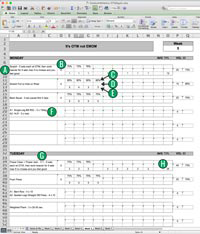
A. Exercise and any related notes on execution or notation, such as the number of reps of each movement in a set of a complex, pause times and positions, or any prescribed rest times.
B. This will auto-populate with your PR for the exercise from the first page of the program.
C. Percentage of the weight for this set.
D. Weight for this set. This will be calculated automatically if this is a prescribed percentage and you have entered your PRs on the first page of the program. You can also manually enter the weight for non-prescribed intensity sets or if you had to modify the workout.
E. TOTAL number of reps in this set. For most exercises, this will be obvious. For complexes (including clean & jerk), this will show the TOTAL of all reps in a set! For example, a clean & jerk single is 1 clean + 1 jerk (shown in the exercise box as Clean & Jerk – 1+1), which is 2 total reps per set. Snatch Pull + Snatch – 2+1 would show 3 reps (see Point G).
F. Exercises listed with a letter and number are intended to be performed as supersets, i.e. do one set of each exercise before returning to the next set of the first exercise. If no rest times are prescribed, you’re expected to keep moving fairly continuously but it’s not a race for time.
G. Example of rep count for an exercise with multiple movements. Power Clean + Power Jerk – 1+1 means one of each movement, so a total of 2 reps, per set, as indicated in the rep field.
H. For OTM exercises, this number simply adds the reps that aren’t accounted for to the left due to the way the sheet is laid out—it simply makes the volume count accurate.
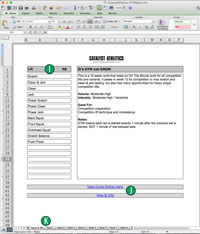
I. Enter your PRs to the right of each box. This will allow the sheet to calculate weights in the program.
J. The top link will get you to the program page on the website if you want to view it in a different format or post/read comments/questions. The bottom link will bring you to the help page for programs that will answer just about any question you could possibly have.
K. Access the weeks of the program with the tabs at the bottom.
ONLINE COACHING
Get proven Olympic weightlifting programming and video technique coaching from Greg Everett for an affordable monthly rate. FREE 7-Day trial.
 Training Programs
Choose from 61 different Olympic weightlifting training programs from Greg Everett, both free and premium, to suit your needs. Our training programs have been used by 111,107 athletes around the world!

Weightlifting prescriptions will be notated with the exercise, the intensity (loading), reps and sets. For example:
Snatch – 75% x 2 x 5
This would indicate snatching 75% of the athlete’s 1RM snatch weight for 5 sets of 2 reps. If a load is not specified, notation for sets and reps will be in the reverse order. For example:
Pull-ups – 5 x 10
This would indicate 5 sets of 10 reps.
For exercise complexes, notation will usually include reps for each exercise performed in the set. This would look, for example, like:
Power Clean + Power Jerk - 75% x 2+1 x 4
This would mean each set is 2 power cleans followed by 1 power jerk at 75%.
Power Snatch + Snatch Balance - 75% x 2(1+1) x 5
This would indicate that each set is 1 power snatch, then 1 snatch balance, then 1 power snatch, then 1 snatch balance for 4 total reps per set.
Prescribed percentages are of the exercise they accompany unless noted otherwise. A notable exception is snatch or clean pulls or deadlifts: percentages of these exercises are calculated from the 1RM of the snatch or clean (this is usually noted in the workout for clarity).
Often exercises will have other types of loading prescriptions, including HS (heavy single) and max.
HS (Heavy Single)
HS or Heavy single indicates taking the exercise to the heaviest weight for a single rep that can be managed in that training session. This is determined simply by gradually increasing the weight until that criterion is met without any failed attempts. If an attempt does fail, but the reason for failure is obviously technical in nature, the athlete can make another attempt. Otherwise the loading increase should stop when the athlete completes a rep he or she is confident is approximately the best possible at that time.
Max
Max is a genuine test of a maximal effort. In this case, the athlete can give him- or herself up to 3 attempts at a given weight. If after 3 attempts the athlete is still unsuccessful, he or she is done with that exercise. An exception would be an athlete who is missing based on minor and known technical errors, and who is able to continue making attempts that are at least as close or better than previous attempts at that weight. In such cases, continued attempts are recommended until this trend reverses.
Similar to the heavy single would be multiple reps with the "heavy" notation, e.g. heavy 3. This simply means taking the exercise up to the heaviest set of 3 reps you feel you're able to do that day.
RM
RM stands for "rep max" and means you'll take the exercise up to a maximum weight for the prescribed reps, e.g. 3RM, 5RM, 1RM. If percentages follow an RM prescription, they are of that day's RM, not of the athlete's current 1RM. For example:
3RM, 90% x 3 x 2
This would mean taking the exercise up to a max weight for 3 reps, then doing 2 more sets of 3 at 90% of that maximum weight.
Sometimes it will be noted alongside RMs that they should not be absolute max testing on that day, but very challenging.
No weight prescribed
If a loading prescription is absent for a particular exercise, the athlete should choose the loading to approximate the heaviest possible for the prescribed sets and reps unless some other quality is prescribed. For conditioning workouts, attempt to select weights that allow you to perform the prescribed reps consecutively in at least the first set.
Bold Weights or Reps
If a weight or rep number is bold, it means that you can increase it for that set if you feel good. This is not a suggestion to take the exercise to a max effort, and you need to stick with the same number of prescribed sets written.
+ Abbreviations
OTM:On The Minute (AKA EMOM)
This is a series of sets performed at the start of each subsequent minute. For example, 75% x 1 x 5 OTM would mean a single at 75% each minute. This is NOT 1 minute rest. If the first set begins at minute 0, the second set begins when the clock hits 1 minute.
HS: Heavy Single
HS or Heavy single indicates taking the exercise to the heaviest weight for a single rep that can be managed in that training session. This is determined simply by gradually increasing the weight until that criterion is met without any failed attempts. If an attempt does fail, but the reason for failure is obviously technical in nature, the athlete can make another attempt. Otherwise the loading increase should stop when the athlete completes a rep he or she is confident is approximately the best possible at that time.
RM: Repetition Maximum
RM stands for "rep max" and means you'll take the exercise up to a maximum weight for the prescribed reps, e.g. 3RM, 5RM, 1RM. If percentages follow an RM prescription, they are of that day's RM, not of the athlete's current 1RM.
+ Exercises
In addition to some well-known exercises, our workouts occasionally use some less-well-known exercises, particularly weightlifting movements. Descriptions and video demonstrations can be found in the Exercise Library.
With exercises requiring higher degrees of technical precision, spend the time developing a solid technique base before attempting to load them heavily. More time invested early in technique work will pay off in the long run.
A good time to do this is prior to the beginning of the next cycle.
Exercise Library
+ Ab & Back Work
Ab work should be performed every training day, even if not prescribed in the workout. Include back work as well at least 1 day/week (e.g. back extensions, reverse hypers, back planks) if not prescribed in the workouts.
Check out this article for info on ab and back work.
+ Rest Periods
Rest as needed between sets without getting lazy. Generally 2-3 minutes is good. For extremely tough work like heavy, high volume squats, 3-5 minutes rest can be taken if needed.
+ Tempo Prescriptions
Certain exercises will be accompanied by a 4-digit number that prescribes a speed at which the lift should be executed. The first digit refers to the eccentric portion (lowering); the second to the time between the finish of the eccentric and concentric portions; the third the concentric (lifting/raising); and the fourth the time between the completion of the concentric and beginning of the following eccentric portion. An "X" indicates performing the portion of the movement as quickly as possible.
For example, a good morning with the tempo 3020 would mean that the athlete would take 3 seconds flex the hip into the bottom positions, not pause, take 2 seconds to extend the hip back to the standing position, and not pause at the top before beginning the next rep.
+ Accessory Work
In addition to the primary weightlifting training, most programs also have accessory work.
In many cases, this work will be done in compound/super sets; that is, you will alternate between or among the exercises rather than completing all sets of each exercise before moving to the next. Such sets will be prescribed with letters and numbers associating exercises in each compound set.
For example:
3 sets:
A1. Pull-ups x 10
A2. Weighted sit-ups
If there were "B" exercises following these, all 3 sets of A1 and A2 would be completed before the B sets were started.
This structure does not mean it's intended to be done quickly—do it at a natural pace. If you do want to get some light conditioning work, you can move through this accessory work as fast as possible BUT prioritize the quality of execution over speed.
Adding Your Own Accessories
Some older programs don't contain accessory work, and at other times you may want or need to add exercises or switch prescribed exercises for others that you know to be most effective for you for that purpose.
This is fine—just be smart about how much you're doing and remember that even seemingly minor, light exercises do add up and affect your recovery.
+ Combining Programs
Many individuals ask if they can perform both our training and other training simultaneously. While we can’t predict everyone’s response to training, we can say with certainly that very few individuals will be able to handle such a workload for any considerable period of time without burning out completely.
These programs are complete and accordingly demanding—attempting to do 2 complete training proprams simultaneously is a recipe for overtraining and poor results.
Just as importantly, combining multiple programs is a good indicator that you're trying to achieve conflicting goals at the same time - this never works well.
If you must combine programs, choose a lower volume and frequency program (use the program filter to select) here and make sure you can manage the workload before considering doing more.
+ Modifying The Program
Individuals may find these workouts too demanding, at least initially. In these cases, the workouts can be modified as needed to accommodate the athlete’s recovery ability. Reduce the number of work sets while keeping the weight the same to reduce volume as needed. If this is inadequate, weights can be lowered slightly.
For individuals who are not yet technically proficient with the Olympic lifts, the prescribed percentages will not elicit the desired physiological effect. Because these individuals’ 1RMs are limited by technique rather strength and power, the percentages will be too light and occasionally obviously unchallenging.
Athletes will need to use their best judgment in determining how much heavier to take the lift by using the original percentage as a guideline—for example, if the prescribed loading is 95%, the athlete should be very challenged by the chosen weight; if it’s 65%, the loading should be relatively easy.
See this article for more information on modifying the programs.
+ Warming Up
If cold, begin the warm-up with some type of monostructural activity like rowing or cycling.
After a 2-5 minutes of this initial warm-up, proceed to foam rolling or similar that you find effective, and then some basic Dynamic Range of Motion (DROM) exercises, and then any specific prep/pre-hab work you need.
After this, move on to a specific warm-up with the barbell appropriate for the workout of the day.
Don’t overdo it—this is a warm-up, not a workout. If you have specific items you want to work on that are not included in the workout, save them for the end so you don’t inadvertently tire yourself out for the actual training.
+ Spreadsheet Guide
Following is a quick rundown of elements of the program spreadsheets you might find unclear. Click the images to enlarge
A. Exercise and any related notes on execution or notation, such as the number of reps of each movement in a set of a complex, pause times and positions, or any prescribed rest times.
B. This will auto-populate with your PR for the exercise from the first page of the program.
C. Percentage of the weight for this set.
D. Weight for this set. This will be calculated automatically if this is a prescribed percentage and you have entered your PRs on the first page of the program. You can also manually enter the weight for non-prescribed intensity sets or if you had to modify the workout.
E. TOTAL number of reps in this set. For most exercises, this will be obvious. For complexes (including clean & jerk), this will show the TOTAL of all reps in a set! For example, a clean & jerk single is 1 clean + 1 jerk (shown in the exercise box as Clean & Jerk – 1+1), which is 2 total reps per set. Snatch Pull + Snatch – 2+1 would show 3 reps (see Point G).
F. Exercises listed with a letter and number are intended to be performed as supersets, i.e. do one set of each exercise before returning to the next set of the first exercise. If no rest times are prescribed, you’re expected to keep moving fairly continuously but it’s not a race for time.
G. Example of rep count for an exercise with multiple movements. Power Clean + Power Jerk – 1+1 means one of each movement, so a total of 2 reps, per set, as indicated in the rep field.
H. For OTM exercises, this number simply adds the reps that aren’t accounted for to the left due to the way the sheet is laid out—it simply makes the volume count accurate.
I. Enter your PRs to the right of each box. This will allow the sheet to calculate weights in the program.
J. The top link will get you to the program page on the website if you want to view it in a different format or post/read comments/questions. The bottom link will bring you to the help page for programs that will answer just about any question you could possibly have.
K. Access the weeks of the program with the tabs at the bottom.
ONLINE COACHING
Get proven Olympic weightlifting programming and video technique coaching from Greg Everett for an affordable monthly rate. FREE 7-Day trial.
Training Programs
Choose from 61 different Olympic weightlifting training programs from Greg Everett, both free and premium, to suit your needs. Our training programs have been used by 111,107 athletes around the world!
Many individuals ask if they can perform both our training and other training simultaneously. While we can’t predict everyone’s response to training, we can say with certainly that very few individuals will be able to handle such a workload for any considerable period of time without burning out completely.
These programs are complete and accordingly demanding—attempting to do 2 complete training proprams simultaneously is a recipe for overtraining and poor results.
Just as importantly, combining multiple programs is a good indicator that you're trying to achieve conflicting goals at the same time - this never works well.
If you must combine programs, choose a lower volume and frequency program (use the program filter to select) here and make sure you can manage the workload before considering doing more.
+ Modifying The Program
Individuals may find these workouts too demanding, at least initially. In these cases, the workouts can be modified as needed to accommodate the athlete’s recovery ability. Reduce the number of work sets while keeping the weight the same to reduce volume as needed. If this is inadequate, weights can be lowered slightly.
For individuals who are not yet technically proficient with the Olympic lifts, the prescribed percentages will not elicit the desired physiological effect. Because these individuals’ 1RMs are limited by technique rather strength and power, the percentages will be too light and occasionally obviously unchallenging.
Athletes will need to use their best judgment in determining how much heavier to take the lift by using the original percentage as a guideline—for example, if the prescribed loading is 95%, the athlete should be very challenged by the chosen weight; if it’s 65%, the loading should be relatively easy.
See this article for more information on modifying the programs.
+ Warming Up
If cold, begin the warm-up with some type of monostructural activity like rowing or cycling.
After a 2-5 minutes of this initial warm-up, proceed to foam rolling or similar that you find effective, and then some basic Dynamic Range of Motion (DROM) exercises, and then any specific prep/pre-hab work you need.
After this, move on to a specific warm-up with the barbell appropriate for the workout of the day.
Don’t overdo it—this is a warm-up, not a workout. If you have specific items you want to work on that are not included in the workout, save them for the end so you don’t inadvertently tire yourself out for the actual training.
+ Spreadsheet Guide
Following is a quick rundown of elements of the program spreadsheets you might find unclear. Click the images to enlarge
A. Exercise and any related notes on execution or notation, such as the number of reps of each movement in a set of a complex, pause times and positions, or any prescribed rest times.
B. This will auto-populate with your PR for the exercise from the first page of the program.
C. Percentage of the weight for this set.
D. Weight for this set. This will be calculated automatically if this is a prescribed percentage and you have entered your PRs on the first page of the program. You can also manually enter the weight for non-prescribed intensity sets or if you had to modify the workout.
E. TOTAL number of reps in this set. For most exercises, this will be obvious. For complexes (including clean & jerk), this will show the TOTAL of all reps in a set! For example, a clean & jerk single is 1 clean + 1 jerk (shown in the exercise box as Clean & Jerk – 1+1), which is 2 total reps per set. Snatch Pull + Snatch – 2+1 would show 3 reps (see Point G).
F. Exercises listed with a letter and number are intended to be performed as supersets, i.e. do one set of each exercise before returning to the next set of the first exercise. If no rest times are prescribed, you’re expected to keep moving fairly continuously but it’s not a race for time.
G. Example of rep count for an exercise with multiple movements. Power Clean + Power Jerk – 1+1 means one of each movement, so a total of 2 reps, per set, as indicated in the rep field.
H. For OTM exercises, this number simply adds the reps that aren’t accounted for to the left due to the way the sheet is laid out—it simply makes the volume count accurate.
I. Enter your PRs to the right of each box. This will allow the sheet to calculate weights in the program.
J. The top link will get you to the program page on the website if you want to view it in a different format or post/read comments/questions. The bottom link will bring you to the help page for programs that will answer just about any question you could possibly have.
K. Access the weeks of the program with the tabs at the bottom.
Following is a quick rundown of elements of the program spreadsheets you might find unclear. Click the images to enlarge
 |
 |
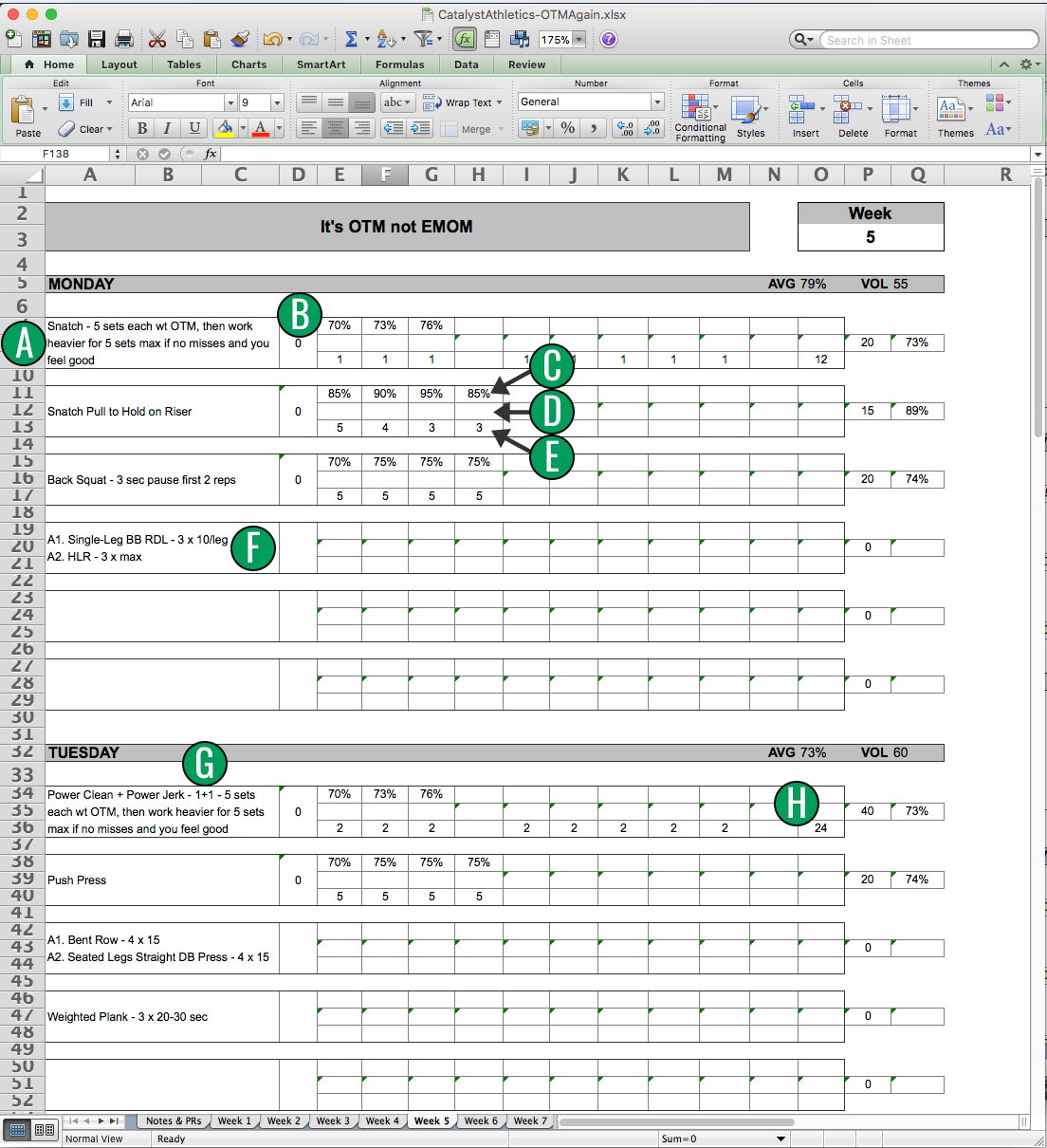
A. Exercise and any related notes on execution or notation, such as the number of reps of each movement in a set of a complex, pause times and positions, or any prescribed rest times.
B. This will auto-populate with your PR for the exercise from the first page of the program.
C. Percentage of the weight for this set.
D. Weight for this set. This will be calculated automatically if this is a prescribed percentage and you have entered your PRs on the first page of the program. You can also manually enter the weight for non-prescribed intensity sets or if you had to modify the workout.
E. TOTAL number of reps in this set. For most exercises, this will be obvious. For complexes (including clean & jerk), this will show the TOTAL of all reps in a set! For example, a clean & jerk single is 1 clean + 1 jerk (shown in the exercise box as Clean & Jerk – 1+1), which is 2 total reps per set. Snatch Pull + Snatch – 2+1 would show 3 reps (see Point G).
F. Exercises listed with a letter and number are intended to be performed as supersets, i.e. do one set of each exercise before returning to the next set of the first exercise. If no rest times are prescribed, you’re expected to keep moving fairly continuously but it’s not a race for time.
G. Example of rep count for an exercise with multiple movements. Power Clean + Power Jerk – 1+1 means one of each movement, so a total of 2 reps, per set, as indicated in the rep field.
H. For OTM exercises, this number simply adds the reps that aren’t accounted for to the left due to the way the sheet is laid out—it simply makes the volume count accurate.
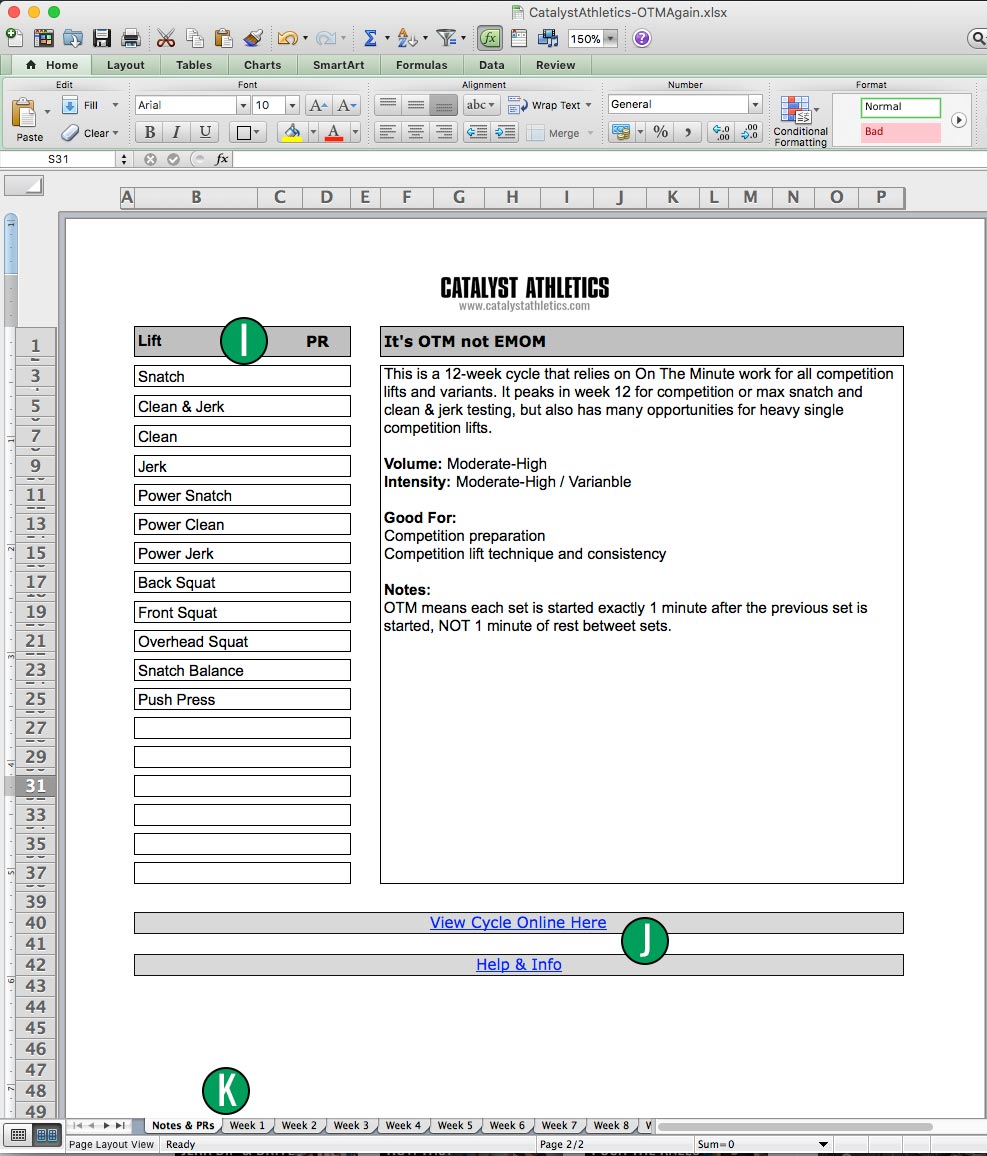
I. Enter your PRs to the right of each box. This will allow the sheet to calculate weights in the program.
J. The top link will get you to the program page on the website if you want to view it in a different format or post/read comments/questions. The bottom link will bring you to the help page for programs that will answer just about any question you could possibly have.
K. Access the weeks of the program with the tabs at the bottom.
Get proven Olympic weightlifting programming and video technique coaching from Greg Everett for an affordable monthly rate. FREE 7-Day trial.
Choose from 61 different Olympic weightlifting training programs from Greg Everett, both free and premium, to suit your needs. Our training programs have been used by 111,107 athletes around the world!


